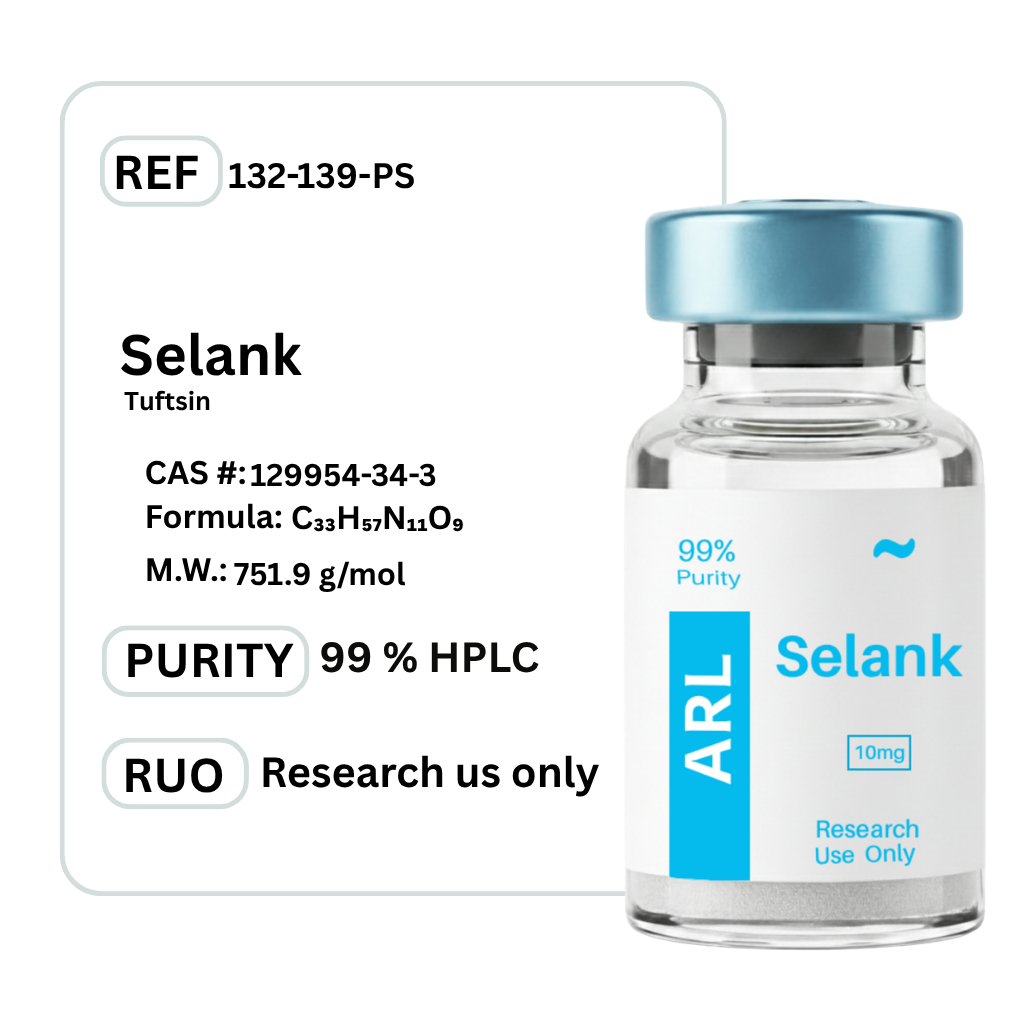
Transcriptomic Analysis of the Gene Expression Modulator (Selank)
1. Introduction to the Gene Expression Modulator (Selank)
The Gene Expression Modulator, known commercially as Selank, is a potent synthetic peptide initially developed for its anxiolytic and nootropic properties. However, its significant influence on gene transcription has positioned it as a powerful research tool in the fields of transcriptomics, genomics, and molecular biology. This document details the observed effects of Selank on messenger RNA (mRNA) levels across various biological pathways, highlighting its utility in advanced research contexts.
Selank is a heptapeptide derived from the endogenous human tetrapeptide tuftsin. Its mechanism of action extends beyond classical receptor binding, demonstrating a profound regulatory impact on gene expression, which is crucial for understanding complex biological systems such as neural circuitry and inflammatory responses.
2. Research Focus: Transcriptomics and mRNA Analysis
The primary focus of current research utilizing Selank is the comprehensive analysis of gene expression changes at the mRNA level (transcriptomics). By quantifying and analyzing the changes in the transcriptome following Selank administration, researchers can map out the affected molecular pathways and identify novel regulatory networks.
mRNA analysis provides a sensitive snapshot of the cell's functional state, as the abundance of specific mRNA molecules directly correlates with the potential for protein synthesis. Selank's utility lies in its ability to selectively and significantly alter the steady-state mRNA levels of numerous genes, making it an indispensable tool for investigating gene function and regulatory mechanisms.
3. Detailed Transcriptomic Effects
Selank exhibits distinct and reproducible effects on gene expression in three primary areas: genes related to the GABAergic system, genes expressed in the hippocampus, and genes involved in inflammation and cytokine signaling.
3.1. Impact on GABA Pathway Genes
The Gamma-Aminobutyric Acid (GABA) system is the primary inhibitory neurotransmission system in the mammalian central nervous system. Selank's interaction with this pathway is complex, involving direct and indirect modulation of the genes that encode key components of GABAergic neurotransmission.
Selank has been found to significantly influence a core group of 7 genes directly related to GABA pathways, suggesting a focused regulatory effect on essential components of GABA synthesis, degradation, or receptor function. Furthermore, a moderate but reproducible effect has been observed on an additional 45 genes within the broader GABA-related pathways. This extensive modulation indicates Selank’s potential to fine-tune inhibitory neurotransmission, offering a tool to study the plasticity and compensation mechanisms of the GABAergic system.
Category
Number of Affected Genes
Degree of Influence
Core GABA Genes
7
Significant
Associated GABA Genes
45
Moderate
3.2. Hippocampal Gene Expression Alterations
The hippocampus is a critical brain region involved in learning, memory, and emotional regulation. Transcriptomic analysis of hippocampal tissue post-Selank administration reveals significant gene alterations, underscoring its role in neuroplasticity and cognitive function research.
Selank alters the mRNA expression levels for 36 genes specifically within the hippocampus. A notable feature of these altered genes is that many encode for plasma membrane proteins. This suggests that Selank may be directly influencing the functional properties of hippocampal neurons by modifying their cell surface characteristics, including receptor density, ion channel function, or cell-to-cell communication molecules.
Affected Area
Number of Genes
Key Protein Types
Hippocampus
36
Plasma Membrane Proteins
3.3. Modulation of Inflammation and Cytokine Genes
Selank’s influence extends beyond the nervous system to the regulation of the immune response. It acts as a modulator for approximately 34 genes associated with inflammation and cytokine production. This finding opens avenues for research into the molecular mechanisms underlying the neural-immune axis and how the central nervous system can influence peripheral inflammatory responses.
The modulation of cytokine genes suggests that Selank could be used to study the intricate feedback loops between pro- and anti-inflammatory signals. This makes it an ideal compound for in vitro and in vivo research focused on molecular immunology and the transcriptomic signatures of neuroinflammation.
4. Visual Evidence of Transcriptomic Changes
The full extent of Selank's regulatory activity is best visualized through global gene expression analysis. The following is a placeholder for the graphical representation of these data.
5. Research Applications and Ideal For
Selank's unique and specific gene modulation profile makes it highly suitable for several advanced molecular biology and life science research areas.
5.1. Genomics Research
Selank is a valuable tool for researchers aiming to validate the functional role of specific gene variants or regulatory elements. By using Selank to induce specific patterns of gene expression, researchers can link changes in the transcriptome to observable cellular or behavioral phenotypes.
5.2. PCR Analysis and Validation
Given the well-characterized effect on distinct gene sets (7 core GABA, 36 hippocampal, ~34 inflammation), Selank provides a robust positive control or experimental perturbation for quantitative Polymerase Chain Reaction (qPCR) and reverse-transcription PCR (RT-PCR) assays. Its predictable effects allow for the reliable normalization and validation of gene expression protocols.
5.3. Molecular Biology Workshops
In educational and training settings, Selank can be used in molecular biology workshops to demonstrate the principles of gene expression regulation, microarrays, RNA sequencing (RNA-Seq) data analysis, and validation techniques.
Research Area
Application Detail
Genomics
Functional validation of regulatory elements
PCR Analysis
Positive control for GABA and Hippocampal gene assays
Molecular Biology Workshops
Demonstration of transcriptomic data generation and analysis
6. Experimental Design Considerations
6.1. Administration and Dosage
Successful transcriptomic analysis relies on a well-defined administration protocol. Typical research protocols involve single or repeated subcutaneous or intraperitoneal injections. The effective dose range varies based on the species (e.g., murine models) and the specific genes targeted.
Parameter
Guideline
Model System
[Model System Placeholder]
Dose Range
[Dosage Placeholder]
Time Points for Analysis
[Time Point Placeholder]
6.2. Sample Preparation and Quality Control
High-quality RNA is paramount for reliable transcriptomic data. The following steps are critical:
- Tissue Dissection: Rapid and precise dissection of target tissues (e.g., hippocampus, prefrontal cortex).
- RNA Extraction: Use a validated method to ensure high purity (A260/A280 ratio >1.8) and integrity (RNA Integrity Number (RIN) >7.0).
- cDNA Synthesis: Reverse transcription using random hexamers or oligo(dT) primers.
For best results, all sample collection and storage should be linked to the experimental timeline:
RNA extraction should occur immediately after tissue harvest or samples should be flash-frozen and stored at -80°C until processing on Date.
7. Transcriptomics Methodology Overview
The primary method for characterizing Selank's impact is high-throughput RNA sequencing (RNA-Seq), which offers an unbiased view of the entire transcriptome.
7.1. RNA-Seq Pipeline
The workflow typically follows these steps:
- Library Preparation: Preparation of sequencing libraries from isolated mRNA.
- Sequencing: Running the libraries on a high-throughput sequencer.
- Bioinformatics Analysis:
- Quality Control: Filtering raw reads.
- Alignment: Mapping reads to the reference genome.
- Quantification: Counting reads per gene.
- Differential Expression Analysis (DEA): Identifying statistically significant changes in gene expression between Selank-treated and control groups.
Differential Expression Analysis is performed using specialized software available at File.
8. Safety and Restriction Notice
IMPORTANT RESEARCH RESTRICTION
Selank is designated strictly as a research chemical for in vitro and in vivo animal model studies only. It is NOT for human therapeutic use. This product is to be handled only by qualified scientific personnel under controlled laboratory conditions at approved research facilities such as Place. Researchers must adhere to all local and international ethical guidelines for handling research chemicals and animal subjects. For inquiries regarding safety data sheets and handling instructions, please contact Person or refer to the document: File.
9. Future Research Directions
Future transcriptomic studies utilizing Selank should focus on:
- Dose-Response Kinetics: Mapping the concentration-dependent effects of Selank on the identified gene sets.
- Cell Type Specificity: Using single-cell RNA sequencing (scRNA-seq) to determine which specific neuronal or glial cell types are responsible for the observed hippocampal gene changes.
- Epigenetic Crosstalk: Investigating whether Selank's transcriptional effects are mediated by epigenetic modifications (e.g., DNA methylation, histone acetylation).
We encourage researchers to discuss their proposed experimental design with our scientific support team by scheduling an initial consultation: Calendar event.
10. Conclusion
Selank, the Gene Expression Modulator, is a precisely characterized tool for transcriptomic research, offering specific and significant modulation of key genes in the GABA, hippocampal, and inflammatory pathways. Its utility in genomics, PCR analysis, and advanced molecular biology studies provides a robust platform for unraveling complex regulatory networks, provided its usage adheres strictly to the research-only restriction.